
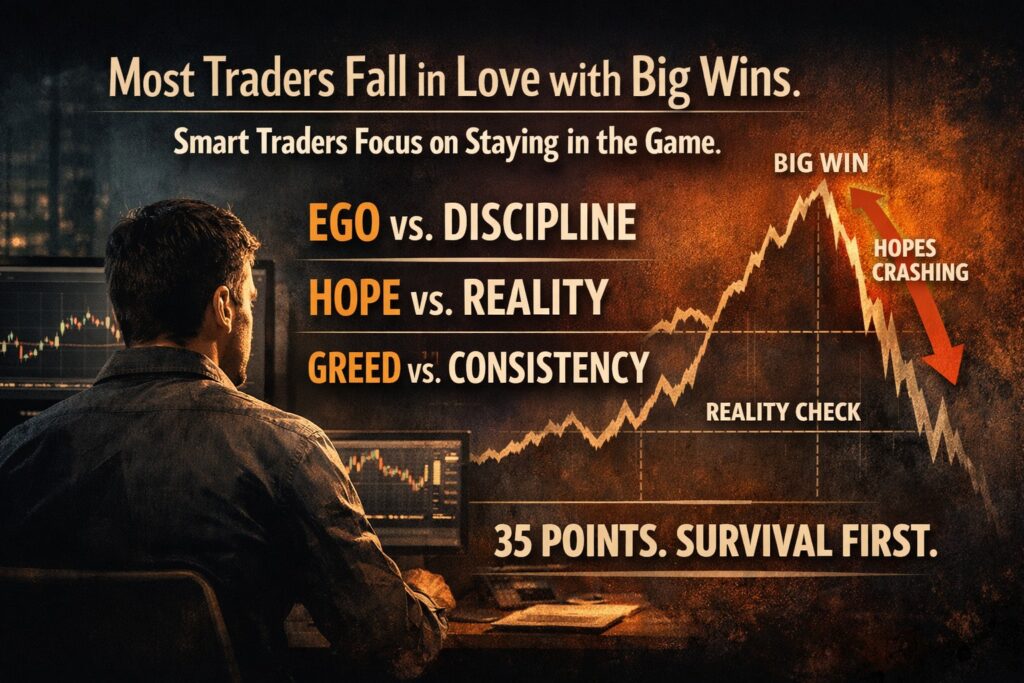
Most traders focus on profit. I focus on staying in the game.
I didn’t lose money on that trade.
But that’s not the point. The point is understanding why I clung to a floating profit — and what that reveals about most traders.
At first, the trade moved in my favor. The numbers looked good. I started imagining the bigger move. Maybe this one would run. Maybe this time I’d catch the “real” trend.
That’s when the danger begins: when you stop trading probabilities and start trading hope.
By the time price came back near my entry, I wasn’t holding an edge anymore. I was defending my ego: if I was wrong, my entry could have marked the exact point where the market rolled over. And I knew it.
So I chose to step aside. Not because I was weak. But because I refused to turn a winning position into a gambling session.
This is where my framework — the 35-point strategy — comes into play. It’s designed to let me capture consistent profits without being hostage to the market’s swings.
The Lie of “Let Your Winners Run”
The most repeated advice in trading is:
“Let your profits run.”
It sounds sophisticated. It sounds disciplined.
But here’s the uncomfortable truth: most retail traders do not have the psychological capacity to manage a running winner.
They don’t trail it systematically. They don’t scale out rationally. They don’t think in expectancy.
They stare at the screen. They imagine the upside. They fear missing out.
And then they watch the market take everything back.
Letting profits run without structure isn’t discipline. It’s romanticism.
Boundaries Over Greed
People hear “35 points” and think it’s small. But it’s not about the number.
It’s about boundaries. It’s about deciding in advance how much of the market you need — and refusing to negotiate with greed mid-trade.
Thirty-five points is my edge. It’s my framework for survival.
Consistency compounds. Ego doesn’t.
Survival is not a phase in trading. It is the foundation. You don’t thrive first and then survive. You survive long enough to thrive.
The Real Edge
The real edge in trading is not prediction.
It’s self-control under temptation.
It’s knowing when your mind shifts from probability to fantasy.
It’s recognizing when you’re no longer executing a system, but protecting your pride.
I didn’t exit that trade because I was afraid. I exited because I refuse to let a floating profit turn into a psychological trap.
That’s the difference between trading for dopamine and trading for longevity.
And longevity is the only edge that compounds. That’s why I trade not just for profit, but for the discipline to stay in the game — every single day.