
When I first started trading, I was like someone with OCD—I wanted to enter a trade every single day. As long as the market moved, I felt I had to be involved, as if missing any price movement was a loss. I stared at the screen all day, watching prices jump, my hand itching to press the “enter” button.
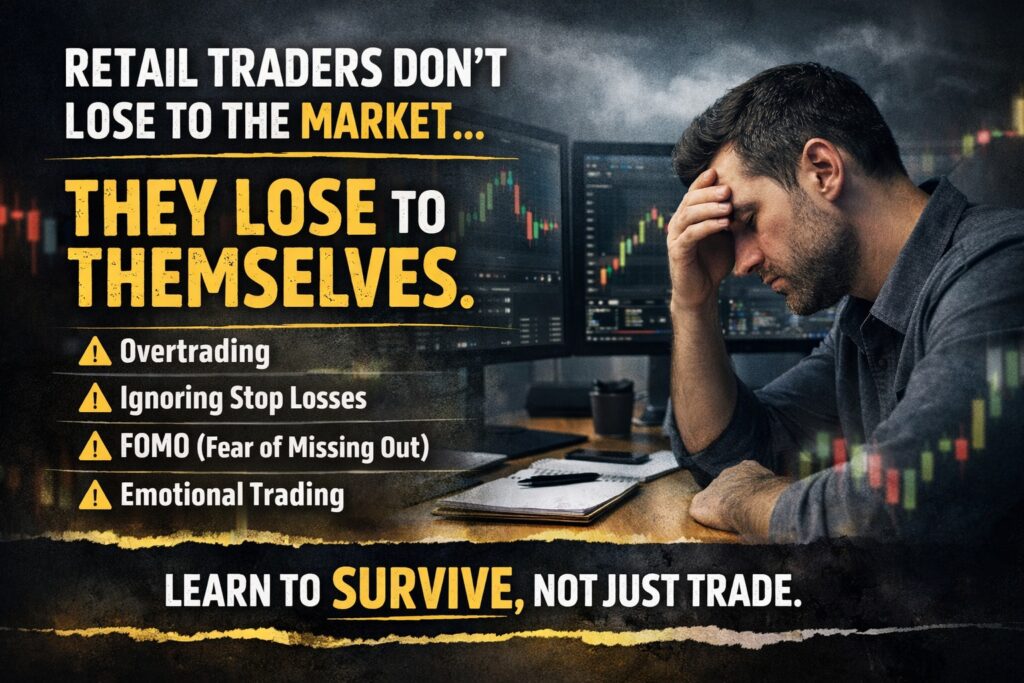
But more trades didn’t lead to more profits. On the contrary, my capital kept shrinking, and my hard-earned gains were slowly eaten away by fees and spreads. One day, I lost an entire month’s profits in just a single trade. That’s when I truly realized:
Most retail traders don’t lose to the market—they lose to themselves.
Looking back at my trades and observing other traders, I discovered that the most common mistakes are actually simple—but they repeat endlessly.
⚠ Mistake #1: Overtrading
Many retail traders think they should make money every day. The moment the market moves, they rush in; they close one trade and immediately look for the next opportunity.
The result? A day full of trades that rarely hit high-probability setups. Low-quality entries and exits accumulate losses over time. In the end, it’s not the market that drains your account—it’s fees, slippage, and repeated poor decisions.
⚠ Mistake #2: Not Stopping Losses
Traders often say they’ll set a stop-loss—but the moment the market moves against them, they start rationalizing:
“Let’s wait a little longer,” “It should bounce back.”
Small losses grow into big losses, short-term trades turn into long-term traps, and one bad trade can wipe out all the gains you’ve worked so hard for.
⚠ Mistake #3: Lack of Patience
Retail traders often suffer from FOMO—Fear of Missing Out. They panic to enter as soon as the price moves, only to find the move stops or reverses, often buying at the top and selling at the bottom.
The reason is simple: a lack of patience to wait for a proper pullback and a safe entry.
High-probability trades are waited for, not chased.
The market rewards those who think and wait patiently.
⚠ Mistake #4: Trading on Emotion
Losses lead to revenge trades. Wins inflate confidence, prompting larger positions. One bad trade can erase all previous gains. When trading becomes an emotional outlet rather than disciplined execution, both your account and your mood swing wildly.
Emotion is the biggest enemy in trading.
Over time, I realized something crucial:
Consistent profits come from waiting, not constant action. Sometimes being flat-handed is more important than being fully invested.
I also learned that not every trade needs to be held to the end. You must distinguish between trades meant for steady gains and trades that deserve letting profits run.
These lessons sound simple, but it took me over five years to truly understand the essence of trading and the market.
The market is always open, but good opportunities aren’t daily. Mature traders wait for the conditions to align, admit mistakes when they occur, preserve capital, and prepare for the next opportunity.
✅ How I Changed My Trading
- Only enter trades when the strategy conditions are met. No signal, no trade.
- Set stop-loss before every trade and exit immediately if the market moves against me.
- Let winning trades run as long as the conditions hold.
- Limit the number of trades to avoid emotional decision-making.
Trading is never truly difficult because of techniques—it’s difficult because of controlling yourself. Indicators can be learned. Strategies can be modified. But discipline and patience are what keep you in the market long term.
In the coming weeks, I will share the pitfalls I’ve hit in trading and how to build a system that allows you to survive and thrive in the markets.
I hope my experiences help others avoid unnecessary mistakes and gradually find their own rhythm in trading.